International Organization for Standardization
Why Your Organization Needs ISO
ISO is an international standard that strengthens your organization’s management system — enhancing efficiency, transparency, and credibility. It’s more than just a certificate — it’s a system that builds long-term trust and sustainable growth.
We offer comprehensive, end-to-end services for ISO system implementation. Our process covers every stage, including organizational analysis, documentation design, team training, internal audits, and full support until you achieve certification from a Certification Body (CB).
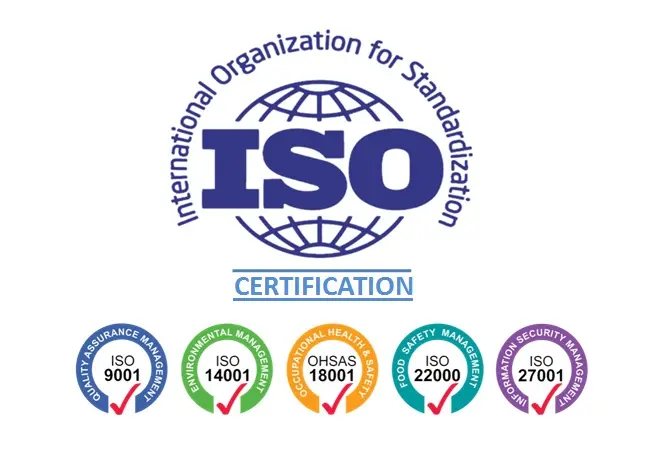
ISO Standards and Business Applications
Quality & Management Systems
ISO 9001:2015 – Quality Management System
ISO 31000:2018 – Risk Management Guidelines
ISO 22301:2019 – Business Continuity Management System
Environment, Safety & Social Responsibility
ISO 14001:2015 – Environmental Management System
ISO 45001:2018 – Occupational Health & Safety Management System
SA 8000:2014 – Social Accountability Standard
Information Security & Privacy
ISO 27001:2022 – Information Security Management System
ISO 27701:2019 – Privacy Information Management System
Food Safety & Hygiene Standards
GHP – Good Hygiene Practices
HACCP – Hazard Analysis and Critical Control Points
HALAL – Halal Certification
ISO 9001:2015 Quality Management Systems
It is the fundamental international standard focusing on improving an organization's internal work processes to be more efficient. The goal is to consistently deliver products and services that meet customer requirements and enhance customer satisfaction.
- Customer Focus: The primary focus is on understanding and meeting customer needs.
- Leadership: Top management must establish policies and demonstrate commitment to implementing the system.
- Process Approach: Managing activities as interrelated processes to see the bigger picture and control them more effectively.
- Continual Improvement: The organization must constantly seek opportunities to improve its processes and system.
- Evidence-based Decision Making: Decisions must be based on the analysis of factual data and information.
ISO 31000:2018 (A Guideline, Not a Certifiable Standard)
This standard provides guidelines, not requirements for certification. It offers principles and a framework for managing all types of risks an organization faces.
- Principles of Risk Management: e.g., integration, customization, consideration of human and cultural factors.
- Framework: Consists of leadership, integration, design, implementation, evaluation, and improvement.
- Risk Management Process: The steps of identifying, analyzing, evaluating, and treating risks.
ISO 22301:2019 Business Continuity Management Systems (BCMS)
This standard helps an organization to prepare for and respond to disruptive incidents (e.g., floods, fires, IT outages) to ensure that critical business functions can continue and recover quickly.
- Business Impact Analysis (BIA): Identifying the most critical business processes and the impact if they are disrupted.
- Risk Assessment: Assessing the risks of events that could cause business disruption.
- Business Continuity Strategy: Planning how to maintain business operations, such as having a backup office or data backup systems.
- Plan Development and Exercising: Creating concrete response plans and conducting regular drills to ensure they are effective.
ISO 14001:2015 Environmental Management Systems
This standard helps an organization to systematically manage the environmental impacts of its activities. It focuses on pollution prevention, compliance with environmental laws, and the sustainable use of resources.
- Identification of Environmental Aspects: The organization must identify which of its activities impact the environment (e.g., water usage, waste discharge).
- Legal Compliance: The organization must identify and comply with all relevant environmental laws and regulations.
- Objectives and Targets: Setting clear goals to reduce environmental impact (e.g., reduce electricity consumption by 10%).
- Emergency Preparedness and Response: Having a plan for emergencies that could harm the environment (e.g., chemical spills).
ISO 45001:2018 Occupational Health and Safety Management Systems
This standard is focused on creating a safe working environment by identifying hazards, assessing risks, and implementing control measures to prevent work-related accidents and illnesses.
- Hazard Identification & Risk Assessment: Finding workplace hazards (e.g., working at height, loud noise) and assessing their risk level to establish controls.
- Worker Participation: Encouraging employees at all levels to participate in suggesting and improving safety measures.
- Hierarchy of Controls: Applying risk control principles in a specific order: Elimination, Substitution, Engineering controls, Administrative controls, and finally, Personal Protective Equipment (PPE).
- Management of Change: When a change occurs, such as introducing new machinery, its safety risks must be assessed beforehand.
SA 8000:2014 Social Accountability
An international standard focused on human rights and decent labor conditions in the workplace, ensuring that employees are treated ethically.
- No Child Labor or Forced Labor.
- Health and Safety in the workplace.
- Freedom of Association and the right to collective bargaining.
- No Discrimination.
- Appropriate Working Hours and Remuneration in compliance with the law.
ISO 27001:2022 Information Security Management Systems (ISMS)
This standard focuses on protecting an organization's critical data and information assets from unauthorized access, breaches, or destruction.
- The CIA Triad:
- Confidentiality: Preventing access to information by unauthorized individuals.
- Integrity: Maintaining the accuracy and completeness of information.
- Availability: Ensuring that information is accessible when needed.
- Information Security Risk Assessment: Identifying and assessing risks to the organization's information assets.
- Controls Selection: Implementing security controls from the standard's Annex A to mitigate identified risks.
ISO 27701:2019 Privacy Information Management Systems (PIMS)
An extension to ISO 27001, this standard specifically addresses the protection of personal data (in line with regulations like GDPR or Thailand's PDPA).
- Extension of ISO 27001: Applies the requirements of ISO 27001 to the context of managing personal information.
- Defines Roles of Controller and Processor: Establishes clear requirements for the organization as either a Data Controller or a Data Processor.
- Data Protection Principles: Creates processes that align with global privacy principles, such as consent, purpose limitation, and data subject rights.
GHP (Good Hygiene Practice)
The most fundamental foundation of food safety. It sets out the minimum sanitary and hygiene practices to prevent contamination at all stages.
- Premises Hygiene: Design and maintenance of food production buildings to ensure cleanliness and prevent pests.
- Control of Operation: Control of raw materials, waste management, transportation.
- Maintenance and Sanitation: Tools and equipment must always be clean.
- Personal Hygiene: Requirements for employee health, cleanliness, and clothing.
HACCP (Hazard Analysis and Critical Control Point)
A preventive management system that focuses on analyzing and controlling biological, chemical, and physical hazards in the food production process.
- Conduct a Hazard Analysis.
- Determine Critical Control Points (CCPs), e.g., the temperature for pasteurization.
- Establish Critical Limits, e.g., must heat to at least 72°C.
- Establish a system to Monitor the CCPs.
- Establish Corrective Actions.
- Establish Verification procedures to confirm the system's effectiveness.
- Establish Documentation and Record Keeping.
HALAL
A certification standard confirming that a product has been processed in a way that is permissible under Islamic law.
- Raw Materials: Must not be forbidden (Haram), such as pork, alcohol, or animals not slaughtered according to Islamic principles.
- Production Process: There must be no cross-contamination with forbidden substances at any stage.
- Slaughtering: Animals must be slaughtered according to Islamic rites by a Muslim.
- Traceability: The origin of raw materials and processes must be traceable.